
Poured-in-Place Rubber
Engineered to Perform
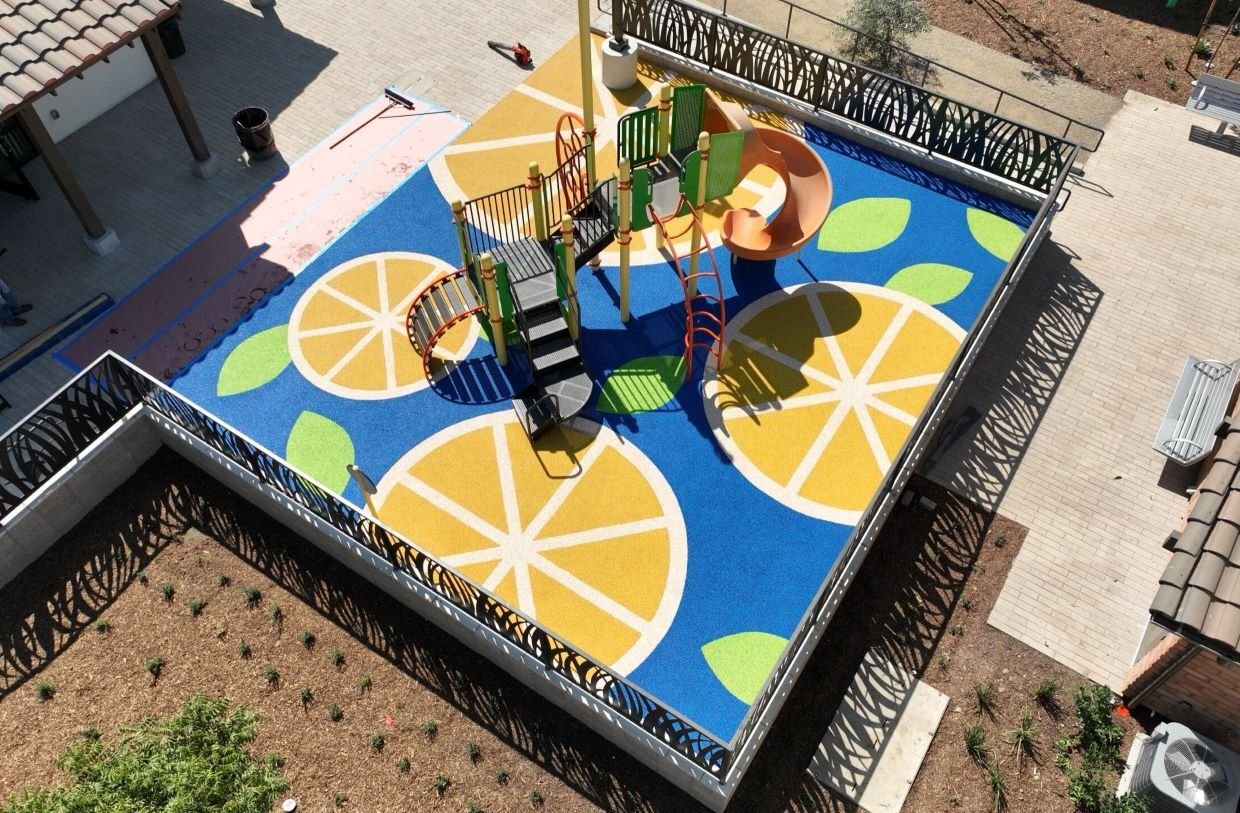
Rubber Surfacing Built for Design Flexibility
Poured-in-Place rubber surfacing delivers seamless, fully customizable safety surfaces built to last. Vibrant color palettes, custom design capabilities, and certified fall protection, all in one precision-installed system.
Why Choose Poured-in-Place Rubber?
Poured-in-Place rubber surfacing system gives you the freedom to bring complex visions to life without sacrificing the technical performance that critical-use environments demand.
Engineered as a two-layer system, poured-in-place rubber combines a base layer for impact attenuation with a dense wear layer available in EPDM or TPV, both UV-stable and offered in an extensive range of colors and custom patterns. The result is a seamless surface that meets ASTM F1292 and ADA accessibility standards while offering virtually unlimited design potential, from branded playground themes to geometric inlays and custom logo integration.
Additional reasons to consider poured-in-place rubber include:
-
Unmatched Customization: Poured-in-Place rubber gives you full creative control. Choose from an extensive EPDM or TPV color palette, mix colors within a single surface, or incorporate custom logos, patterns, and themed graphics.
-
Certified Safety Performance Every poured-in-place installation is engineered to meet ASTM F1292 fall attenuation standards and IPEMA certification requirements. Thickness specifications are calculated to your site's critical fall height.
-
ADA-Compliant Accessibility: Pour-in-Place construction eliminates seams, edges, and loose-fill gaps that create trip hazards and accessibility barriers. This surfacing is the right choice for inclusive playgrounds and public spaces required to meet ADA compliance.
-
Long-Term Durability: Formulated with UV-stable EPDM or TPV wear layers and a high-density rubber base, poured-in-place is built to withstand heavy foot traffic, freeze-thaw cycles, and years of direct sun exposure without significant fading, cracking, or delamination.
-
Low Maintenance, High ROI: Unlike loose-fill surfacing that requires regular top-offs and raking, poured-in-place requires minimal ongoing maintenance. Routine cleaning and periodic inspections are all that's needed to keep the surface performing at spec.
Whether you're speccing a municipal playground, a school campus, or a multi-use recreation area, poured-in-place rubber gives you a surface that's as precise as your plans.
-
Vibrant & Customizable
Vibrant & Customizable
-
Meets Fall Height Requirements
Meets Fall Height Requirements
-
Durable & Long-Lasting
Durable & Long-Lasting
-
Accessible & Inclusive Design
Accessible & Inclusive Design
Where to Find Poured-in-Place
From installers to material suppliers, you can find poured-in-place rubber from our list of brands.
Installers


Material Suppliers


-1.webp?width=285&height=54&name=Sparton%20Logo%202024%20(10)-1.webp)
The Poured-in-Place Difference
| When | Where | How Poured-in-Place Can Help |
|
You’re planning a brand new playground or park |
School playgrounds, city parks, destination playgrounds, early childhood centers |
Creates a continuous safety surface around equipment, engineered for fall heights, with colors and patterns that match your design. |
|
Your existing surface is breaking down or hard to maintain |
Play areas with loose fill (mulch, sand, pea gravel) or worn tiles/mats |
Provides a stable, low-maintenance surface that doesn’t scatter or wash away and reduces ongoing topoff and raking. |
|
You need better accessibility and inclusive play |
Inclusive playgrounds, ADA routes, transfer points, sensory play areas |
Offers a smooth, seamless, wheelchair-friendly surface, making it easier for wheelchairs, walkers, and strollers to move. |
|
You have taller equipment or complex layouts |
Structures with higher fall heights, ramps, mounds, climbers, net structures |
Can be poured to exact thicknesses for safety compliance and contoured around curves, posts, and slopes without trip edges. |
|
You’re designing year-round play and recreation spaces |
Indoor playgrounds, recreation centers, childcare facilities, fitness or agility areas |
Provides a clean, quiet, slip-resistant surface that’s easy to sanitize and comfortable underfoot all year long. |
|
You’re focused on long-term value, not just the lowest first cost |
High-traffic community parks, schools, and facilities with long-term maintenance responsibility |
Delivers strong lifecycle value—less frequent replacement, reduced upkeep, and durable performance in heavy use. |
|
You’re coordinating with new equipment installation |
Any new playground or major renovation |
Installing PIP with your new equipment ensures exact fit, clean edges, and a unified finish from day one. |
Frequently Asked Questions
When is poured-in-place best installed?
For the best results, PIP surfacing should be installed when:
- Weather is dry – The base needs to be clean and dry for proper bonding.
- Temperatures are moderate – Avoid extremes of heat or cold so the material cures evenly.
- Base work is complete – Concrete or asphalt base and playground equipment should be installed and inspected first.
- Access is available – Crews need clear access to the site for materials, mixing, and finishing.
How is thickness determined for a playground surfacing project?
Thickness is calculated based on the critical fall height, which is the distance between your highest piece of equipment and the playground surfacing below. Thickness requirements should be documented and verified through third-party testing upon installation.
What is the expected lifespan of poured-in-place rubber and what does maintenance involve?
A properly installed poured-in-place surface typically performs for 10–15 years depending on traffic volume, climate conditions, and maintenance practices. Routine care involves periodic washing with mild detergent and water, along with annual inspections to check for surface wear, drainage performance, and edge integrity. Localized damage can be patched without full surface replacement, extending the usable life of the installation.
What makes poured-in-place rubber an accessible surface?
Poured-in-place rubber is engineered to meet the standard for playground surface accessibility. The rubber surface eliminates gaps, seams, and displacement that can impede accessible travel. Unlike loose-fill materials, poured-in-place maintains consistent performance across the surface area without shifting or compacting unevenly over time.
How are color and design elements added to poured-in-place rubber?
Custom colors, patterns, and logo inlays are achieved using pigmented EPDM or TPV in the wear layer. Design elements are mapped to the site plan and poured in sections to create clean, precise boundaries between colors. Complex graphics and branded themes are often coordinated during the pre-installation design phase.
Poured-in-Place Rubber Request a Quote
Got a project? Our team can help you find the best possible option for your vision.