
Testing & Compliance
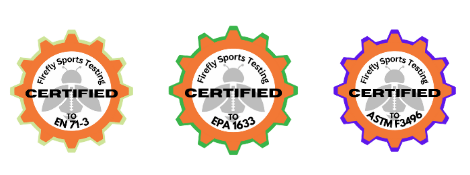
About Our Tests
The Surfacing Group playground systems are third-party certified and lab tested to recognized safety and material standards. Below is a quick summary of what that means.
Testing Standards
Our surfacing systems undergo rigorous evaluation across four critical safety categories.
PFAS Analysis (EPA Method 1633)
What it evaluates: Tests for an extensive range of per- and polyfluoroalkyl substances (PFAS), commonly known as "forever chemicals," within surfacing materials.
Why it's important: Demonstrates that PFAS compounds are not detected above minimal laboratory reporting thresholds—providing assurance of safer recreational spaces and confidence for purchasers.
PAH Assessment (ASTM F3496 / "PAH8")
What it evaluates: Identifies eight priority polycyclic aromatic hydrocarbons (PAHs)—compounds associated with incomplete combustion processes or off-gassing, as it's sometimes referred to.
Why it's important: Validates that PAH concentrations remain at or below established safety benchmarks, supporting responsible material choices for spaces where children play.
Heavy Metal Testing (EN 71-3 & ASTM F3188)
What it evaluates: Employs toy industry testing protocols (EN 71-3) to measure the potential migration of heavy metals (such as lead, mercury, or arsenic) from surface materials, plus ASTM F3188 to check extractable metals under simulated stomach-acid conditions.
Why it's important: Verifies minimal risk of metal leaching from playground surfaces—meeting rigorous safety standards designed for children's products and reducing potential exposure to heavy metals in children's environments.
To learn more about the test results, please refer to the individual brand sites for specifics.
Playground Safety with IPEMA
In the interest of playground safety, the International Play Equipment Manufacturers Association (IPEMA) provides a Third Party Certification program.
Through this third-party program, a designated independent laboratory, TÜV SÜD America Inc. (TÜV), validates a surfacing manufacturer’s certification of compliance to ASTM F1292, Standard Specification for Impact Attenuation Under and Around Playground Equipment Performance Criterion (in its entirety). To view a list of current validated products, their thickness and critical height, click below.
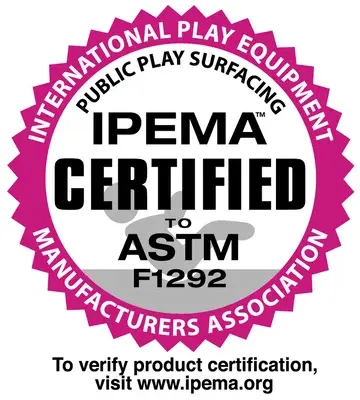
IPEMA Certifications (ASTM Performance)
The Surfacing Group's brands are independently certified to meet—often exceed—ASTM impact performance standards at their stated fall heights when installed to specification.
How certification works (who does what):
- IPEMA administers the certification program for playground surfacing.
- TÜV SÜD America, serving as IPEMA’s independent certification body, performs the testing/validation and issues certificates to the relevant standards.
- The certificates confirm that our configurations meet the g-max and HIC performance requirements defined in ASTM F1292.
To learn more about the systems covered, please refer to the individual brand sites for specifics.
FREQUENTLY ASKED QUESTIONS
What are the main playground surfacing standards?
The main playground surfacing standards often include ASTM F1292 for impact attenuation, ASTM F1951 for accessibility, ASTM F3313 for field testing, CPSC playground safety guidelines, ADA playground surfacing requirements, and IPEMA certification considerations. Together, these help owners and specifiers evaluate safety, access, installation quality, and long-term performance.
What does ASTM F1292 mean for playground surfacing?
ASTM F1292 is focused on impact attenuation, which means how well a playground surface helps absorb impact from a fall. It is used to evaluate surfacing performance within the use zone of playground equipment and is closely tied to critical fall height requirements.
How does ADA compliance affect playground surfacing?
ADA compliant playground surfacing should support accessible routes and usable play areas for children, caregivers, and visitors with varying mobility needs. ASTM F1951 playground accessibility testing helps evaluate surface firmness, stability, and how difficult it is to move across the surface.
Is IPEMA certification required for playground surfacing?
IPEMA certification is not always required, but it can provide added confidence that a playground surfacing product has been tested to applicable ASTM standards. Many owners, schools, municipalities, and specifiers use IPEMA certified playground surfacing as part of their product review process.
How do fall height requirements affect surfacing selection?
Playground surfacing fall height requirements are based on the equipment installed above the surface. The surfacing system must be selected and installed to support the critical fall height of the play structure, which is why equipment layout and surfacing specifications should be reviewed together
What is the best playground safety surfacing option?
There is no one-size-fits-all answer. The best playground safety surfacing option depends on the site, budget, accessibility goals, maintenance expectations, climate, equipment fall height, and owner priorities. A strong specification looks at the full system, not just the surface material.
Why does maintenance matter for playground surfacing compliance?
Even a properly selected surface can lose performance if it is not maintained. Routine inspection, cleaning, repairs, top-offs for loose-fill systems, and documentation help protect impact performance, accessibility, drainage, and long-term value.